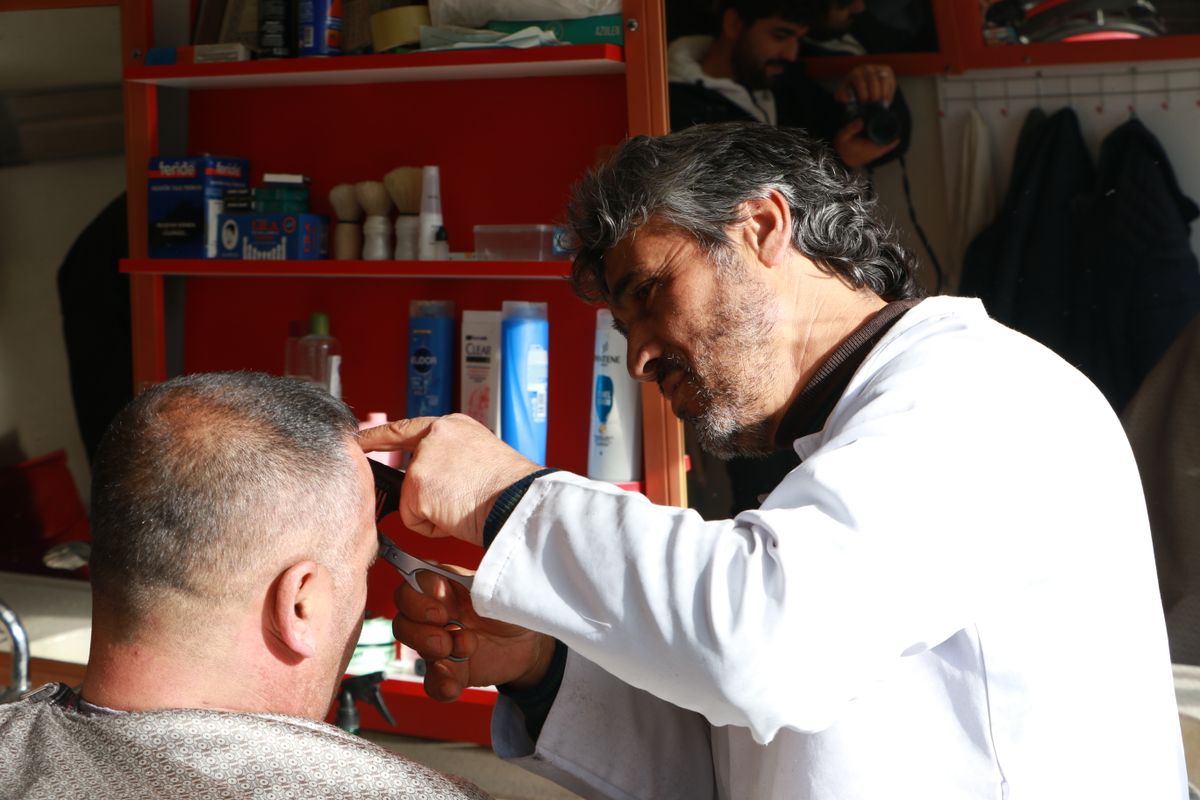
A Georgia barbershop does not have to choose between being “walk-in only” and “appointment only.” It can operate a controlled hybrid system: reserve defined barber capacity for appointments, expose only genuinely available capacity to walk-ins, quote a range rather than a promise, and stop adding people to the queue when the remaining service capacity is no longer credible. The operating question is not which model sounds friendlier. It is whether the shop can state who is waiting, which barber may legally and operationally perform the requested service, how long the requested service is expected to occupy a workstation, which appointments are protected, and what happens when actual service time differs from the plan.
The queue must sit behind Georgia authorization, not replace it. Before serving either a walk-in or an appointment, the shop should separately verify the practitioner’s active credential and service scope, the active salon/shop or facility license under which the service is performed, and the applicable city/county business and premises approvals for the exact address. A pending facility application is not permission to open, a facility license does not authorize an unlicensed individual, and a state salon/shop license is not the local business license or occupational tax certificate. [GA-CB-RULE-240-6-03, GA-CB-RULE-240-12-01, GA-CB-SOS-HOWTO-SHOP-01, GA-CB-SOS-FAQ-01]
Once those gates are satisfied, use four operating controls:
- Define each service request before placing it in a queue: requested service, practitioner qualification needed, estimated active time, cleanup/reset time, client constraints, and whether the request is accepted, waiting, scheduled, deferred, declined, cancelled, or completed.
- Calculate capacity from the actual barbers, workstations, operating intervals, known appointments, observed service durations, and required reset work. Do not insert an internet “average haircut time,” universal utilization target, or expected walk-in rate.
- Protect appointments from a hidden walk-in backlog. Offer walk-ins only capacity that remains after appointment commitments, required breaks, setup, sanitation, and a documented uncertainty allowance chosen by the operator from its own records.
- Review outcomes with counts and ranges: arrivals, accepted requests, quoted waits, actual waits, abandoned waits, appointment delays, completed services, resets, rework, complaints, and unavailable intervals. Do not treat booked value as cash, every open minute as sellable, or every declined walk-in as lost profit.
This framework can make the decision process visible. It cannot guarantee short waits, legal compliance, a particular worker classification, increased revenue, a safe product, an inspection result, or an appropriate staffing level.
- A Georgia barbershop does not have to choose between being “walk-in only” and “appointment only.” It can operate a controlled hybrid system: reserve defined barber capacity for appointments, expose only genuinely available capacity to...
- The queue must sit behind Georgia authorization, not replace it.
- Once those gates are satisfied, use four operating controls:
1. Scope and non-claims
This draft addresses the operational coordination of walk-ins and appointments at a Georgia barbershop that intends to provide regulated barber services at a fixed, authorized location. It is written as a planning framework for an owner, manager, or team lead. It is not legal, licensing, tax, accounting, payroll, wage-and-hour, worker-classification, occupational-safety, accessibility, fire, building, zoning, insurance, infection-control, medical, product-safety, or financial advice.
The guide does not provide:
- a universal walk-in quota, appointment percentage, utilization target, service duration, price, staffing ratio, wait-time promise, break schedule, buffer, cancellation rule, or closing cutoff;
- a conclusion that any named service may be performed by a particular credential holder;
- a conclusion that a pending application, displayed document, suite arrangement, booth-rental agreement, or business registration authorizes operation;
- a city or county business-license, zoning, occupancy, fire, plumbing, signage, parking, or accessibility checklist for a selected address;
- a worker classification, compensation model, payroll treatment, unemployment-insurance result, workers’ compensation result, or tax treatment;
- a conclusion that a product, process, tool, ventilation design, disinfectant, or exposure control is safe or compliant;
- a promise that a quoted wait is accurate, that a barber will be available, that a walk-in will be served, or that an appointment will start exactly on time;
- a claim that a declined or abandoned request is lost revenue or lost profit; or
- a recommendation to collect sensitive personal, health, disability, immigration, family, or financial information from a client merely to manage a queue.
Georgia’s current professional rules and statutes are volatile. The official Department 240 compilation used by the research ledger states a June 30, 2026 cutoff. The code, live rules, applications, forms, Board notices, and later legislation require a fresh check before publication. The signed 2024 legislation supports narrow definitions and exceptions that it changed; it does not by itself prove the full current content of every section in the governing chapter. [GA-CB-CODE-PORTAL-01, GA-CB-STATUTE-2024-01, GA-CB-RULES-2026-01]
This draft assumes ordinary barber operations only for planning. It does not cover medical aesthetics, cosmetic laser, body art, permanent makeup, diagnosis or treatment of dermatological conditions, or any other service outside the verified barbering scope. If the actual menu includes a service that may cross a professional or product boundary, remove it from the queue until a qualified reviewer maps the exact service, purpose, tools, products, person, and location to current authority. The 2024 Georgia source describes narrow exceptions for certain activities and limits them when other licensed practices are added; no operator should turn those exceptions into a broad “no license needed” category. [GA-CB-STATUTE-2024-01]
The methods below intentionally avoid external operational studies and vendor benchmarks. The shop must populate every duration, arrival pattern, capacity allowance, conversion field, and cost input from its own dated records or labeled planning assumptions. A planning assumption is not evidence merely because it appears in a spreadsheet.
3. Define the operating model before opening the queue
A hybrid shop needs a written promise that staff can apply consistently. “Walk-ins welcome” can mean at least four different things: a client may enter and ask; a client may join a same-day queue; a client may receive service if a qualified barber has capacity; or the shop promises service before closing. Those meanings are not interchangeable.
Write a plain-language operating statement that covers:
- whether walk-in requests are accepted all day or only during documented intake periods;
- whether joining the queue is in person, by phone, online, or through another approved channel;
- whether the queue is shop-wide or barber-specific;
- whether clients may leave and return, and how their place is handled;
- whether a quote is a range, an estimate, or an appointment offer;
- what happens when the requested service cannot be confirmed at check-in;
- what happens when the expected wait extends beyond the shop’s credible capacity;
- how clients receive updates and how a communication failure is handled;
- which appointments remain protected from walk-in assignment;
- when intake stops even though the shop remains open for existing commitments; and
- how accessibility or communication needs are routed without requiring unnecessary personal details.
Do not publish a “first come, first served” promise unless the actual matching logic is truly chronological. A strict chronological queue can be incompatible with service scope, barber skill authorization, barber-specific requests, workstation constraints, appointments, cleanup status, and service duration. A more accurate statement may explain that service order depends on arrival time, requested service, qualified-barber availability, existing appointments, and operational readiness. That statement still needs legal, consumer-communication, accessibility, and operator review before public use.
Choose the unit of capacity
Decide whether the shop plans capacity by barber, workstation, service interval, or a combination. Barber time usually matters, but a service may also depend on a particular chair, sink, tool set, product-control process, or reset step. A provider who is present but completing sanitation, documentation, checkout, or a required break is not available service capacity.
For each planning interval, record:
- qualified barber minutes available;
- workstation minutes available;
- fixed appointment commitments;
- required setup and reset minutes based on the shop’s observed process;
- breaks, training, meetings, opening, and closing duties;
- known blocked or unavailable intervals;
- uncertainty allowance chosen from the shop’s own observed variation; and
- walk-in capacity remaining after those items.
Do not force all services into an identical slot. Use observed service families only after confirming that each family contains sufficiently similar work. If a “cut” group mixes simple maintenance work, restyles, add-ons, consultation-heavy services, and services with materially different cleanup, its duration estimate may be too broad to manage a queue.
4. Build a service and queue-state dictionary
Every client request should have one primary state at a time. Otherwise, one request can appear as waiting, abandoned, and completed in the same report.
Service-request fields
Capture the minimum operational data needed to make the assignment:
| Field | Purpose | Boundary |
|---|---|---|
| Request time | Places the request in the operating timeline | Does not guarantee chronological service |
| Requested service | Starts scope and duration review | Marketing name alone is insufficient for licensure analysis |
| Service details | Identifies length, tools, products, and qualification dependencies | Avoid collecting unnecessary sensitive information |
| Barber preference | Records a client preference | Does not make that barber available |
| Qualification required | Prevents assignment outside verified scope | Must come from current authority review, not staff assumption |
| Estimated active minutes | Supports a range from the shop’s own data | Not a universal duration or promise |
| Estimated reset minutes | Protects cleanup and workstation readiness | Must reflect the actual service and current procedure |
| Queue status | Shows current operational state | Exactly one primary state at a time |
| Quote range and time | Preserves what was communicated | A quote is not guaranteed completion time |
| Update channel/status | Shows whether an update was attempted and received | Does not establish permission for unrelated marketing |
| Assigned barber/workstation | Shows the current plan | Assignment may change with a recorded reason |
| Actual start/end/reset time | Supports later analysis | Must be defined consistently |
| Outcome | Completed, cancelled, declined, abandoned, deferred, or unresolved | Do not infer reason without evidence |
Queue-state dictionary
| Primary state | Working definition | Allowed next states | Control |
|---|---|---|---|
intake_unresolved | The requested service, qualification, duration, or client constraint is not yet clear | accepted, declined, deferred | No barber assignment until scope and feasibility are resolved |
accepted_waiting | The shop accepted the request into the active same-day queue and provided a documented estimate range | called, cancelled, abandoned, deferred | Capacity must remain credible when accepted |
called_for_service | The shop notified or invited the client to the ready point | in_service, no_response, cancelled | Record time and channel; do not backdate |
in_service | The client and authorized barber began the defined service | completed, stopped_unresolved | Define what “begin” means operationally |
reset_in_progress | Service ended, but workstation and tools are not ready for reassignment | completed_ready | Do not count the workstation as available |
completed_ready | Service and required immediate closeout/reset state are complete | final | Separate service end from ready-for-next-client time if both matter |
appointment_protected | Capacity is reserved for a scheduled appointment | checked_in, late_unresolved, cancelled, rescheduled | Do not consume invisibly with a walk-in |
deferred | The request was moved to a later offered time or appointment path with client agreement | scheduled, cancelled | Do not count as completed or current waiting |
declined_capacity | The shop did not accept the request because credible capacity was unavailable | final | Not automatically lost revenue |
declined_scope_or_readiness | Service could not be accepted because authority, qualification, product, workstation, or readiness was unresolved | final or reviewed later | Preserve the blocking category without guessing |
abandoned_wait | A previously accepted client left or became unavailable before service | final | Record known facts; avoid assigning motives |
cancelled_by_client | Client withdrew before service | final | Keep distinct from abandonment if the definitions differ |
cancelled_by_shop | Shop could not fulfill the accepted request | final or remedy path | Keep separate from client action |
unresolved | Available evidence cannot establish the correct outcome | resolution required | Exclude from rates until resolved and report the count |
These states are editorial methods. Georgia sources do not prescribe queue software fields or reporting categories.
State integrity rules
- Never create two active queue entries for one request merely because a barber assignment changes.
- Preserve the original request time and every status-change timestamp.
- Record who changed the status and why.
- Do not mark a request completed merely because payment was started or a chair was occupied.
- Do not mark a client abandoned until the shop’s documented contact and grace process has been applied.
- Do not erase a shop cancellation by creating a replacement appointment; link the remedy while preserving the original outcome.
- Keep unresolved records visible. A forced answer improves the spreadsheet, not the underlying evidence.
5. Calculate service capacity without invented benchmarks
Capacity is constrained by the smallest relevant resource. For a simple barber-chair service, both qualified barber time and ready workstation time matter. Additional resources may matter for a specific menu. Do not assume the number of licensed barbers, the number of chairs, or the posted opening hours alone equals service capacity.
5.1 Interval capacity
For each barber and planning interval:
EDITORIAL_METHOD:
net_barber_minutes
  = scheduled_present_minutes
  - breaks_and_nonservice_duties_minutes
  - known_unavailable_minutes
  - protected_appointment_minutes
  - required_setup_and_reset_minutes_not_already_inside_service_estimates
  - operator_uncertainty_allowance_minutes
For each workstation or constrained resource:
EDITORIAL_METHOD:
net_workstation_minutes
  = workstation_open_minutes
  - maintenance_or_unavailable_minutes
  - appointment_reservations_minutes
  - setup_and_reset_minutes
  - operator_uncertainty_allowance_minutes
The operator uncertainty allowance must be explicit. It may be informed by the shop’s own distribution of actual versus estimated times, but this draft does not set its amount. If the shop has no reliable data, label the value as a planning assumption and treat the resulting capacity as low-confidence.
5.2 Service capacity by family
If the shop has a documented service family with an observed planning duration:
EDITORIAL_METHOD:
theoretical_service_units
  = floor(
      min(net_qualified_barber_minutes, net_required_workstation_minutes)
      / planning_minutes_per_service_unit
    )
This number is theoretical. It does not account for arrival timing, barber preferences, service mix, late appointments, client consultation, checkout, products, rework, accessibility needs, or other constraints unless they are included in the inputs. Never report a result when the planning minutes per unit are zero or negative. Return not calculated—invalid duration input.
For mixed services, a single unit calculation can mislead. Use a time-budget model instead:
EDITORIAL_METHOD:
remaining_walk_in_minutes
  = net_service_minutes
  - sum(accepted_walk_in_estimated_active_and_reset_minutes)
A new request can be accepted only if the shop’s matching logic finds a qualified barber, a compatible ready resource, and a feasible interval without consuming protected commitments. This is a planning test, not a guarantee.
5.3 Estimate ranges from first-party observations
Do not build estimates from one unusually fast barber or from memory. Maintain a dated observation set by service family, barber or comparable group where appropriate, location, and operating context. Preserve actual active time and reset-to-ready time separately when both affect the queue.
For editorial planning, the shop may select a lower and upper estimate from its own observed values, but the selection method must be written and reviewed. Do not label a range “90% accurate,” “standard,” or “typical” unless the shop has defined and validated that claim. Small samples, new services, new barbers, seasonal demand, promotions, school schedules, events, weather, and product or equipment changes can make old estimates unreliable.
5.4 Zero and missing-data guards
- If no qualified barber is available, capacity is zero regardless of empty chairs.
- If no compliant workstation is ready, capacity is zero regardless of barber availability.
- If service scope is unresolved, capacity for that service is unavailable rather than zero-demand.
- If the duration is missing, the request stays in intake review or is offered a separately reviewed appointment process.
- If appointment data are incomplete, do not release apparently open time to walk-ins until the conflict is resolved.
- If the facility or local authorization is inactive or unresolved, the queue does not open.
- If the denominator for a rate is zero, report
not calculated—no eligible observations, not0%.
6. Design the walk-in queue
6.1 Intake sequence
Use a short, repeatable sequence:
- Record request time and the client’s requested service in plain language.
- Clarify only the details necessary to identify scope, time, products/resources, and client constraints.
- Check the authorized service matrix and qualified-barber availability.
- Check workstation and sanitation readiness.
- Check protected appointment capacity and accepted walk-in commitments.
- Produce a wait range or explain that the shop cannot offer credible same-day capacity.
- Confirm the client’s barber preference and whether an alternate qualified barber is acceptable.
- Record the accepted queue state and communication method.
- Provide a plain-language explanation of how updates, leaving/returning, and loss of contact are handled.
Do not ask staff to improvise services, split regulated work between people without reviewed authority, shorten sanitation, skip a break, or displace an appointment to make the queue look successful.
6.2 Queue ordering
A practical matching sequence may consider:
- service request time;
- service scope and qualification required;
- client’s accepted barber options;
- barber-specific appointment commitments;
- workstation and implement readiness;
- estimated active and reset time;
- client’s documented time constraint;
- accessible communication or service-arrival arrangement; and
- shop-side recovery obligations from an earlier disruption.
Publish only a description the shop can actually follow. If priority rules exist, identify them and obtain legal/accessibility review. Do not create a hidden category based on spending, perceived status, appearance, accent, disability, age, race, sex, family status, or staff familiarity. This source set does not provide a complete anti-discrimination or public-accommodations analysis, so policy language remains blocked pending qualified review.
6.3 Wait quote
A wait quote should contain:
- time of quote;
- estimate range rather than an unsupported exact minute;
- service and barber assumptions used;
- number or category of known commitments ahead, if the shop chooses to disclose it accurately;
- update point or next contact time;
- what the client should do if the estimate no longer works; and
- a statement that the estimate can change with service duration, arrivals, scope clarification, or shop disruption.
The shop should not expose another client’s identity, service details, or reason for delay. “A current service is taking longer than planned” may be enough. Do not invent a medical or personal explanation.
6.4 Intake stop rule
Define a stop rule before closing pressure develops. The stop rule should be based on remaining credible qualified-barber and workstation capacity, protected appointments, required resets, and closing duties. It should not be a universal clock time copied across days.
Possible internal decision logic:
EDITORIAL_METHOD:
accept_request only when
  verified_service_scope = true
  and qualified_barber_match = true
  and ready_resource_path = true
  and protected_appointments_remain_protected = true
  and estimated_completion_plus_reset_fits_reviewed_operating_boundary = true
If the request fails the test, staff may offer a reviewed appointment option, waitlist for a later interval, or a clear decline. The guide does not prescribe compensation, a discount, or a referral.
7. Protect appointments inside a hybrid schedule
7.1 Appointment capacity is a commitment
An appointment occupies planned capacity before the client arrives. Do not count the same minutes as both available walk-in time and protected appointment time. If a barber-specific appointment requires a specific workstation or service setup, reserve those resources as well.
An appointment record should include:
- booked start time and the time zone policy;
- requested and confirmed service;
- assigned or requested barber;
- planning duration and its evidence date;
- setup/reset dependency;
- arrival/check-in instructions;
- current status and status history;
- any approved accessibility/communication arrangement recorded with minimum necessary detail;
- shop-side changes and client notifications; and
- outcome, including shop cancellation or delay.
This draft does not supply a cancellation, late-arrival, deposit, card, reminder, privacy, or communication-consent policy. Those topics require separate primary evidence and review.
7.2 Pre-appointment capacity review
At a defined point before each appointment, check:
- barber availability and credential status;
- facility and workstation readiness;
- service details and products/tools;
- preceding service risk of overlap;
- setup and sanitation time;
- known shop disruption;
- client communication status; and
- whether current walk-in commitments threaten the protected interval.
If a conflict appears, stop accepting conflicting walk-ins and communicate with affected clients under the reviewed process. Do not wait until the appointment start to discover that the barber is still assigned to a long walk-in service.
7.3 Appointment arrival states
Keep not yet due, checked in, service-ready, shop delayed, client late—unresolved, client cancelled, shop cancelled, rescheduled, and completed distinct. A client who is not visible in the waiting area may still be following an approved arrival arrangement. A client running late does not automatically release the entire slot unless the shop’s reviewed policy and actual communication support that decision.
7.4 Controlled gap release
If the shop chooses to use appointment gaps for walk-ins, define the release decision in advance. Consider whether the walk-in service plus reset can fit before the protected time under the shop’s own observed range. Include the time needed to consult, check in, transition, and prepare—not only clipper-on-client time.
Use an explicit latest-start time:
EDITORIAL_METHOD:
latest_walk_in_start
  = next_protected_appointment_start
  - estimated_walk_in_active_minutes
  - estimated_reset_minutes
  - operator_uncertainty_allowance_minutes
If the current time is later than that result, do not accept the walk-in into that gap. This formula does not establish the correct allowance; it only makes the shop’s assumption visible.
8. Run check-in, service matching, and client updates
8.1 Opening huddle
Before intake begins, the responsible person should review:
- facility and local authorization status, with escalation for any change;
- practitioners present and the service categories each is currently cleared to perform;
- appointment commitments, special setup, and unavailable intervals;
- workstation, implement, product, linen, and storage readiness;
- required notices, license displays, and inspection-report display;
- known product or equipment hold;
- opening sanitation completion;
- walk-in intake channels and responsible staff;
- communication outages or software problems;
- queue stop and escalation owners; and
- closing boundary and incomplete-work plan.
Georgia’s display rule addresses facility and individual licenses, current inspection information, and required rules/signage. The source ledger flags an internal chapter-reference inconsistency that must be clarified with the Board rather than reproduced inaccurately. A stale screenshot must not be treated as proof of active status. [GA-CB-RULE-240-4-02]
8.2 Match the service, not the label
At intake, staff should compare the real requested work with the approved service matrix. If the client changes the service after entering the queue, recalculate qualification, tools, products, duration, reset, price communication, and capacity. Preserve the original request and the accepted change.
The queue should prevent assignment when:
- the service description is ambiguous;
- the practitioner’s active status cannot be verified;
- the requested work may exceed the verified scope;
- required products, label/SDS review, tools, protective controls, or ventilation assessment are unresolved;
- the workstation or implements are not ready;
- the remaining time threatens an appointment or reviewed closing boundary; or
- the facility/local authorization is not active for the operating facts.
8.3 Updates and handoffs
When an estimate changes, record the new range, reason category, time, staff member, communication attempt, and known client response. Do not overwrite the original quote. A useful internal reason list might include current service variance, added service approved, barber unavailable, workstation reset, appointment protection, equipment issue, or unresolved service scope.
At shift handoff, transfer every active queue item, protected appointment, delay, unresolved scope question, and workstation state. The outgoing staff member should not mark records complete merely to clear the screen.
8.4 Accessibility boundary
Offer a way for clients to communicate a functional need or request assistance without requiring a diagnostic narrative. Record only what the reviewed process needs to deliver the arrangement. This evidence set does not establish the shop’s obligations, technical solution, or undue-burden analysis. Named accessibility and legal review is required before public policy language or staff scripts are approved.
9. Keep health, sanitation, and inspection controls inside the flow
Queue pressure is not a reason to shorten or hide a required control. Georgia’s facility rules address hand washing between clients, protective clothing/footwear, waste handling, implement cleansing and disinfection, single-use items, storage, linens, product dispensing, and other health/safety matters. The exact language distinguishes required actions from recommendations and must be preserved. [GA-CB-RULE-240-4-03, GA-CB-RULE-240-4-04, GA-CB-RULE-240-4-05]
9.1 Ready means service-ready
A barber is not ready for the next client until the shop’s actual post-service duties are complete. Depending on the service and reviewed procedure, that can include:
- securing used or single-use items in the correct stream;
- moving dirty implements to labeled separation;
- completing required cleansing and disinfection steps and contact time;
- drying and storing clean implements correctly;
- handling used or contaminated linens;
- cleaning the workstation and relevant equipment;
- washing hands as required;
- restoring products without contaminating them;
- completing minimum records; and
- confirming that the station is safe and supplied for the next verified service.
The Georgia rule in the ledger states that certain multi-use nonporous tools require a defined after-use process, while single-use items are not disinfected and reused. It also states that UV cabinets are storage after proper cleansing/disinfection rather than a substitute for the process. Product labels, EPA registration, manufacturer instructions, compatibility, and professional infection-control review remain necessary. [GA-CB-RULE-240-4-04, GA-CB-RULE-240-4-05]
Do not use the queue guide as a sanitation manual. The exact shop procedure must be written from the current rules, the real implements and products, labels, safety data, manufacturer instructions, and qualified review.
9.2 Inspection visibility
Licensed persons and facilities are subject to inspection, citations, and fines under the current Georgia rule framework. The fine schedule is volatile, may involve multiple instances, and must not be reduced to a stale dollar figure or treated as a price for noncompliance. [GA-CB-RULE-240-2-01-02]
The queue record can help show what happened operationally, but it does not prove regulatory compliance. Preserve separate compliance records for licenses, display, inspection findings, training, products, implements, logs where required, corrective actions, and ownership decisions.
9.3 Product and worker-safety hold
If the barbershop offers a hair-smoothing or other chemical service, maintain an exact product inventory, current labels, and current SDS review. Federal sources in the approved industry ledger describe potential formaldehyde exposure from certain heated smoothing products and the importance of hazard information, but they do not establish exposure at every shop, approve a product, design ventilation, or decide coverage for a particular worker. [FDA-HAIR-01, OSHA-HAIR-01, OSHA-HAIR-02]
Before turning those services on in the queue, identify the applicable occupational-safety authority, the actual worker relationships, exact product and SDS, workplace conditions, exposure assessment, training/control questions, and competent reviewer. The OSHA State Plans source is a jurisdiction directory; it does not say every state rule is identical or decide requirements for this establishment. [OSHA-STATE-01]
10. Resolve worker-model and staffing caveats
The queue may display barbers as interchangeable capacity, but the business cannot treat a worker label as a compliance conclusion. “Employee,” “independent contractor,” “booth renter,” “suite renter,” “commission,” “hourly,” and “chair lease” can describe commercial arrangements, but this source set does not contain a complete classification test or wage-and-hour analysis.
10.1 Questions that must be assigned to a qualified reviewer
- Who controls schedule, prices, services, products, client assignment, queue order, dress, tools, methods, records, payment, refunds, and rework?
- Who contracts with the client and receives payment?
- Who owns or leases the workstation, and under which active facility license does the practitioner work?
- Who is responsible for display, inspection response, sanitation, product inventory, complaints, and incident handling?
- How are walk-ins offered, accepted, declined, or reassigned?
- Can a practitioner accept or decline a request, and what happens operationally and financially?
- How are waiting, opening, closing, reset, training, meeting, and administrative time handled?
- Which entity has payroll, withholding, unemployment, workers’ compensation, tax, and insurance obligations?
- What records are created by the queue, who can access them, and who retains them?
The answers are facts for professional analysis. They are not a do-it-yourself classification score.
10.2 Georgia employer administration
Georgia Department of Labor sources identify employer registration, account, wage-reporting, payment, and new-hire routes and describe general unemployment-insurance administration. They do not decide whether a specific barber is an employee, the correct rate, wage-and-hour duties, or the complete payroll workflow. [GA-DOL-01, GA-DOL-02]
If the reviewed model includes employees, record the employing entity, first payroll facts, registration and account status, payroll owner, filing calendar, new-hire process, and qualified reviewer. Do not publish thresholds, timing, rates, or forms from memory; those elements are volatile and require an action-time check.
The Georgia workers’ compensation source states a general coverage rule for businesses regularly employing three or more people and notes that regular part-time workers and specified entity roles affect the described count. It does not decide status, exemption, premium, policy limit, classification, or coverage for a real shop. Verify the current statute/rules, exact headcount and roles, exemptions, and policy with a qualified Georgia broker or counsel. [GA-SBWC-01]
10.3 Tax and transaction boundary
Georgia tax accounts depend on business structure and activity. The Department of Revenue sources identify the Georgia Tax Center and general categories such as sales/use and withholding, but they do not classify every barber service, retail sale, mixed transaction, package, membership, tip, or payment to a worker. [GA-DOR-01, GA-DOR-02]
The queue and appointment system should therefore preserve clean transaction categories for later accounting review without claiming tax treatment. Record service, retail, package/credit use, discounts, refunds, tips, taxes as configured, worker/service attribution, payment status, and reconciliation status. A software field named “revenue” is not an accounting conclusion.
10.4 Staffing is not just chair coverage
When planning a shift, include all required work:
- opening and closing;
- client intake and updates;
- consultations and scope clarification;
- active service;
- workstation and implement reset;
- product and linen handling;
- checkout and record completion;
- breaks and nonservice duties;
- required training or meetings;
- stock or equipment issues;
- inspection or incident response; and
- manager escalation.
Do not infer that a barber can safely absorb unlimited walk-ins because an appointment column is empty. Actual capacity depends on the reviewed worker model, real schedule, service mix, readiness, and compliance work.
11. Model queue economics without calling estimates profit
The purpose of an operational model is to show where time and money may move, not to prove a financial outcome. Keep demand, capacity, booked value, collected cash, refunds, direct variable cost, labor/pay obligations, overhead, tax, and profit separate.
11.1 Core counts
For a defined observation period:
EDITORIAL_METHOD:
walk_in_requests
  = all unique walk-in service requests received under the written definition

accepted_walk_in_requests
  = requests moved into the active queue

completed_walk_in_services
  = accepted walk-in requests that reached the documented completed state

appointment_requests
  = all unique appointment requests received under the written definition

completed_appointments
  = scheduled appointments that reached the documented completed state
Do not count one client asking about two possible services as two requests unless the shop’s stable definition says why. Do not count a rescheduled appointment as two completed appointments.
11.2 Rates with denominator guards
EDITORIAL_METHOD:
walk_in_acceptance_rate
  = accepted_walk_in_requests / walk_in_requests

accepted_walk_in_completion_rate
  = completed_walk_in_services / accepted_walk_in_requests

walk_in_abandonment_rate
  = abandoned_accepted_walk_ins / accepted_walk_in_requests

appointment_on_time_start_rate
  = appointments_started_inside_reviewed_window
    / eligible_completed_or_started_appointments
Each rate must show the numerator, denominator, dates, definitions, exclusions, and unresolved records. When the denominator is zero, report not calculated—no eligible observations. The “reviewed window” is not supplied here and must not be presented as an industry standard.
11.3 Wait accuracy
EDITORIAL_METHOD:
actual_wait_minutes
  = actual_service_start_time - accepted_queue_time

quote_variance_to_lower_bound
  = actual_wait_minutes - quoted_lower_minutes

quote_variance_to_upper_bound
  = actual_wait_minutes - quoted_upper_minutes
If the client was asked to return later, define whether accepted queue time, return-ready time, or check-back time controls the calculation. Preserve the rule. Do not mix onsite waiting with a virtual queue without disclosing the difference.
Report how many actual waits fell below, inside, or above the quoted range. Do not claim “accuracy” without a written method and sufficient records.
11.4 Capacity use
EDITORIAL_METHOD:
documented_service_and_reset_minutes
  = sum(actual_active_service_minutes + actual_reset_to_ready_minutes)

available_reviewed_minutes
  = minutes the reviewed model classified as available for those activities

capacity_use_ratio
  = documented_service_and_reset_minutes / available_reviewed_minutes
This ratio is not a productivity grade. High use can coincide with long waits, missed breaks, appointment delays, poor records, rushed reset, or staff overload. Low use can reflect deliberate appointment protection, training, access constraints, low demand, downtime, or invalid data. Do not set a universal target from this draft.
11.5 Value and cash
| Measure | Working definition | Do not call it |
|---|---|---|
| Requested service value | Price associated with the client’s initial request under the shop’s documented price version | Revenue, cash, or profit |
| Accepted queued value | Requested value for accepted queue entries | Guaranteed sales |
| Completed service value | Documented service value after approved service changes | Collected cash or accounting revenue |
| Collected amount | Amount actually collected and reconciled under the shop’s reviewed definition | Profit |
| Refunded amount | Amount returned, with timing and reason | Proof the original charge was proper or improper |
| Direct variable input cost | Dated, service-specific input consumed under a reviewed costing definition | Total cost |
| Labor/pay amount | Amount determined under the reviewed worker/payroll model | Entire labor cost or classification conclusion |
| Contribution proxy | A clearly labeled internal model subtracting only explicitly listed inputs from collected amounts | Accounting profit, damages, valuation, or tax result |
Possible internal formula:
EDITORIAL_METHOD:
contribution_proxy
  = collected_amounts
  - refunds_and_reversals
  - documented_direct_variable_inputs
  - documented_labor_or_provider_amounts_under_reviewed_model
  - explicitly_listed_transaction_costs
List every included and excluded item beside the result. Do not compare the proxy with accounting profit. Do not assign value to declined or abandoned requests as if collection were certain.
11.6 Decision view
Review operational and economic measures together:
- Did accepted walk-ins receive credible quotes?
- Did appointment delay increase or decrease under the same definitions?
- Did sanitation/reset records remain complete?
- Did complaints, shop cancellations, rework, or unresolved records change?
- Were breaks and required nonservice duties actually preserved?
- Did collected amounts change after refunds and reversals?
- Did the service mix change?
- Did staffing, hours, prices, products, or promotions change?
- Are the worker, pay, and tax assumptions still under review?
A change that increases completed services while undermining licensing, sanitation, safety, payroll, access, or client communication is not an approved improvement.
12. Measure the system and review changes
12.1 Daily close
At closing, reconcile:
- starting appointments and same-day changes;
- all walk-in requests and unique request count;
- accepted, declined, deferred, cancelled, abandoned, and unresolved requests;
- original and updated wait ranges;
- actual service and reset times;
- appointment delays and shop-side cancellations;
- barber and workstation unavailable intervals;
- scope, credential, product, or readiness holds;
- sanitation/reset completion records maintained under the separate approved procedure;
- collected, refunded, reversed, and unreconciled amounts;
- client complaints and requested follow-up;
- software or communication failures; and
- status changes made after the event.
Do not delete anomalies. Assign an owner and resolution date.
12.2 Period review
Choose a review period suited to the shop’s volume and service cycle. This draft does not prescribe seven days, thirty days, or any other period. Report both counts and rates. Separate day of week, interval, service family, and barber only where the counts and definitions support a fair view. Do not rank barbers from a queue report without accounting for service mix, appointments, hours, qualifications, client preference, unavailable intervals, and data quality.
12.3 Change control
When changing the walk-in policy:
- Freeze the prior policy version and definitions.
- State the operational problem with counts and dates.
- Choose one change where practical.
- Record affected clients, workers, services, and systems.
- Complete licensing, worker, pay, safety, tax, accessibility, and local review as applicable.
- Train staff on the exact new rule and escalation path.
- Set the start date and observation plan.
- Preserve both old and new data definitions.
- Review unintended effects, not only completed-service counts.
- Roll back or revise if the control produces unsafe, misleading, inaccessible, or unmanageable results.
The period is an operator decision. No source in the approved ledgers validates an experiment length or predicts the result.
13. Worked hypothetical scenarios
EDITORIAL_SCENARIO 1 — Protecting an appointment from a short-gap walk-in
All values in this scenario are invented solely to demonstrate the formulas. They are not Georgia requirements, shop benchmarks, expected service times, recommended buffers, or financial forecasts.
A shop’s worksheet shows one qualified barber and one ready chair. The next protected appointment begins at 2:00 p.m. The shop’s own planning assumption for a newly requested walk-in service is a range of 28 to 42 active minutes, plus 8 reset minutes. The operator has entered a 10-minute uncertainty allowance for this planning interval. At 1:12 p.m., the optimistic calculation using 28 minutes would appear to fit, but the reviewed operating rule uses the upper planning bound for gap release.
latest_walk_in_start
  = 2:00 p.m.
  - 42 active minutes
  - 8 reset minutes
  - 10 uncertainty minutes
  = 1:00 p.m.
Because the current time is 1:12 p.m., the request does not fit the protected gap under the shop’s stated assumptions. Staff do not promise completion by 2:00 p.m. They offer the client the next separately verified capacity or an appointment option. The record is declined_capacity or deferred, depending on the client’s choice.
The scenario does not prove that 42, 8, or 10 minutes are appropriate. A real shop must use its actual service definition, observed timing, sanitation process, client communication, and appointment commitments. It must also confirm that the practitioner, facility, and location are authorized before any capacity calculation matters. [GA-CB-RULE-240-6-03, GA-CB-RULE-240-12-01, GA-CB-SOS-HOWTO-SHOP-01]
EDITORIAL_SCENARIO 2 — Mixed demand without a universal walk-in percentage
All values are hypothetical and deliberately do not describe an average barbershop.
During one invented review interval, a shop records 18 unique walk-in requests. It accepts 11 into the active queue, completes 9, records 1 client cancellation, and records 1 abandoned accepted wait. It declines 5 for capacity and 2 because service scope or readiness remained unresolved. The shop also has 12 eligible appointments, of which 10 begin inside the shop’s internally reviewed reporting window, 1 begins outside it because a preceding service exceeded the range, and 1 is cancelled by the shop because of an equipment issue.
walk_in_acceptance_rate = 11 / 18
accepted_walk_in_completion_rate = 9 / 11
walk_in_abandonment_rate = 1 / 11
appointment_on_time_start_rate = 10 / 11 eligible started appointments
The report displays counts next to every rate. It does not recommend accepting a larger share, call five declined requests lost revenue, or treat the unresolved scope/readiness requests as demand that could have been served. The shop reviews the appointment delay, equipment issue, quote history, and sanitation/reset intervals before changing capacity.
If the owner proposes adding a worker or extending hours, the decision is not made from the 18-request count. The shop first resolves the worker model, payroll/employment administration, workers’ compensation analysis, local operating boundary, service credentials, and cost quotes. The Georgia employer sources identify administrative paths but do not classify a worker or supply a staffing answer. [GA-DOL-01, GA-DOL-02, GA-SBWC-01]
EDITORIAL_SCENARIO 3 — Apparent revenue that is not profit
Every number below is hypothetical. None is a price recommendation, expected conversion, tax position, compensation arrangement, or business forecast.
An invented daily record shows completed-service value of $1,140. The shop’s reconciliation shows $1,090 collected during the defined period, $40 refunded, $135 in documented direct variable inputs under its internal costing definition, $410 in labor/provider amounts under a separately reviewed model, and $35 in explicitly listed transaction costs. It calculates an internal contribution proxy:
contribution_proxy
  = $1,090
  - $40
  - $135
  - $410
  - $35
  = $470
The report does not call $1,140 revenue, does not call $1,090 profit, and does not call $470 accounting profit. It lists exclusions such as occupancy, utilities, insurance, software, professional fees, equipment, depreciation, taxes, owner compensation, training, nonservice time, and other overhead or timing items. A qualified accountant must define the real reporting and tax treatment. Georgia Department of Revenue sources show that obligations depend on structure and activity and do not supply a salon-specific treatment for services, retail, packages, memberships, tips, or mixed transactions. [GA-DOR-01, GA-DOR-02]
The shop also records four declined walk-in requests with an initial requested-service value totaling an invented $220. It does not add $220 to “loss” because those requests were not completed or collected and might not have converted even with capacity. The amount remains a request-context field, not damages or profit.
14. Copyable worksheets and checklists
14.1 Georgia authorization worksheet
| Layer | Item | Exact facts | Official verification path | Status | Verified at | Named verifier | Blocker/next action |
|---|---|---|---|---|---|---|---|
| Individual | Practitioner and credential category | Current Board/code path | |||||
| Individual | Active status and service-scope mapping | Current Board/code path | |||||
| Facility | Salon/shop license, operating name, address | Current Board path | |||||
| Facility | Practitioner/suite relationship to facility | Current Board path | |||||
| Facility | Required display and latest inspection report | Current rule/process | |||||
| Local | City/county business authorization | Named local authority | |||||
| Local | Zoning/use and occupancy | Named local authority | |||||
| Local | Fire/building/plumbing/sign/accessibility paths | Named responsible authority | |||||
| Operations | Products, tools, SDSs, sanitation/readiness | Exact current records | |||||
| Workforce | Worker model, payroll, insurance, safety | Qualified review |
Source boundary for this worksheet: state professional/facility and local separation are supported narrowly by the Georgia Board records; exact local approvals remain address-specific and unresolved. [GA-CB-SOS-HOWTO-SHOP-01, GA-CB-SOS-FAQ-01, GA-CB-RULE-240-4-01]
14.2 Service authorization and timing worksheet
| Service name used with clients | Exact acts/tools/products | Credential/scope verification | Qualified barbers | Active-time evidence period | Lower planning bound | Upper planning bound | Reset evidence | Workstation/resource | Confidence/blocker |
|---|---|---|---|---|---|---|---|---|---|
Rules:
- Do not populate credential/scope from job title alone.
- Do not combine unlike services to create a convenient duration.
- Date the observation set and retain raw records.
- Keep active service and reset-to-ready time distinct.
- Mark assumptions as assumptions.
- Remove a service from active queue assignment when authority or readiness is unresolved.
14.3 Daily capacity worksheet
| Planning interval | Barber | Scheduled present minutes | Nonservice duties | Protected appointments | Known unavailable | Setup/reset not in service estimates | Uncertainty allowance | Net barber minutes | Net workstation minutes | Walk-in minutes offered |
|---|---|---|---|---|---|---|---|---|---|---|
Document why each allowance was selected. Never use a negative result as capacity; investigate the schedule conflict. Do not silently reduce protected appointment or sanitation time to make the row positive.
14.4 Walk-in intake form
- Request timestamp:
- Client reference using the minimum necessary identifier:
- Requested service in client’s words:
- Clarified service description:
- Service scope verified for assignment: yes / no / unresolved
- Barber preference:
- Alternate qualified barber acceptable: yes / no / unresolved
- Estimated active-time range and evidence version:
- Estimated reset time and procedure version:
- Compatible workstation ready: yes / no / expected at:
- Protected appointment conflict check:
- Accepted queue state:
- Quote range and quote timestamp:
- Update method and next update point:
- Accessibility/communication arrangement under reviewed process:
- Status history:
- Actual start/end/reset-ready timestamps:
- Final outcome:
- Exception, complaint, or follow-up owner:
14.5 Appointment protection checklist
- Appointment service description remains current.
- Assigned barber is present, active, qualified, and operationally available.
- Facility relationship and workstation are verified.
- Products, tools, implements, linens, and protective controls are ready.
- Setup and reset time are protected.
- Current walk-ins do not consume the protected interval.
- Client arrival and communication status are known under the reviewed process.
- Any delay is recorded and communicated without exposing another client’s information.
- Shop-side cancellation or remedy is preserved as its own outcome.
- Actual start, service end, and reset-ready times are captured consistently.
14.6 Opening checklist
- Facility and local operating status checked for any change.
- Individual licenses and service matrix checked for scheduled practitioners.
- Required licenses, inspection report, rules, and notices displayed/available under current verified requirements.
- Appointments, protected resources, and known unavailable intervals reviewed.
- Workstations, implements, storage, products, linens, and waste controls ready under the separate approved procedures.
- Product labels/SDSs and any safety holds reviewed.
- Queue channels and staff responsibilities assigned.
- Estimate evidence version selected.
- Queue stop and escalation owner named.
- Communication outage fallback ready.
- Accessibility request route ready under reviewed policy.
- Closing boundary and incomplete-request process confirmed.
14.7 Daily close worksheet
| Measure | Count/amount | Definition version | Unresolved records | Notes/owner |
|---|---|---|---|---|
| Unique walk-in requests | ||||
| Accepted walk-ins | ||||
| Completed walk-ins | ||||
| Declined for capacity | ||||
| Declined for scope/readiness | ||||
| Deferred to appointment/later interval | ||||
| Cancelled by client | ||||
| Cancelled by shop | ||||
| Abandoned accepted waits | ||||
| Eligible appointments | ||||
| Appointment starts inside reviewed window | ||||
| Appointment delays | ||||
| Workstation/barber unavailable minutes | ||||
| Completed-service value | ||||
| Collected/refunded/reversed amounts | ||||
| Complaints and follow-ups |
14.8 Worker-model review worksheet
| Question | Actual fact | Document/evidence | Qualified reviewer | Status | Queue-system implication |
|---|---|---|---|---|---|
| Who sets schedule and intake availability? | |||||
| Who sets services and prices? | |||||
| Who assigns walk-ins? | |||||
| Who controls tools/products/methods? | |||||
| Who contracts and collects payment? | |||||
| How is waiting/reset/nonservice time handled? | |||||
| Which facility license covers the work? | |||||
| Who owns compliance and inspection response? | |||||
| Which entity handles payroll/tax/insurance? | |||||
| Who owns and retains client/queue records? |
This worksheet gathers facts only. It is not a classification test.
14.9 Publication-readiness checklist
- Named human author has verified the full draft.
- Named Georgia barbershop operator has tested the workflow with real shop data.
- Named Georgia licensing reviewer has checked the current code, rules, service scope, individual credentials, facility license, and Board processes.
- Exact city, county, and address have been selected.
- Named local reviewer has verified business, zoning, occupancy, building, fire, plumbing, signage, accessibility, and other applicable paths.
- Named employment/payroll reviewer has resolved the worker model and applicable administration.
- Named workers’ compensation reviewer has checked headcount, roles, exemptions, and coverage.
- Named tax/accounting reviewer has approved terminology, transaction mapping, and formulas.
- Named occupational-safety reviewer has checked jurisdiction, products, SDSs, exposures, and controls.
- Named accessibility and legal reviewers have approved intake, queue priority, communication, and accommodation language.
- All source URLs, titles, access dates, limitations, and claim mappings have been refreshed.
- All formulas have zero-denominator and missing-data guards.
- All worked examples remain visibly hypothetical and contain no implied benchmark.
- Public copy contains no promise of service or exact wait not supported by the operating system.
- Immutable revision and publication-gate approval are recorded in the content system.
Private crosslink contract
Persist editorial relations to /topics/operations-management/, /industries/barbershops/, related guides I01/G07/G10/G12, the no-show calculator, cancellation-policy template, and the glossary terms chair-capacity, provider-utilization, no-show-rate, and revenue-per-available-hour. Do not render any public link until both pages are published, index-eligible, resolvable in the same release, and contextually accurate; otherwise keep the relation private or remove it.
Sources and review notes
Sources mapped to this current revision are listed for local review. This localhost-only view remains noindex.
- Hair Smoothing Products That Release Formaldehyde When Heated
- Starting a Business Guide
- Georgia State Board of Cosmetology and Barbers Rules and Laws
- Rule 240-12-.01. Application for Cosmetology/Barber Salon/Shop
- Chapter 240-2. Violations and Fines; Rules 240-2-.01 and 240-2-.02
- Rule 240-4-.01. Requirements of Operating a Facility
- Rule 240-6-.03. Application for Cosmetology License at the Master Cosmetologist, Master Barber, Barber, Hair Designer, Esthetician or Nail Technician Level
- Department 240 — Georgia State Board of Cosmetology and Barbers
- Georgia State Board of Cosmetology and Barbers FAQ
- How-to Guide: Salons & Barber Shop Application
- Senate Bill 354 — As Passed (Act 556)
- Online Services
- Employers FAQs — Unemployment Insurance
- Tax Registration
- Taxes for Business
- Workers' Compensation Insurance FAQs
- Hair Salons: Facts about Formaldehyde in Hair Products — Overview
- Hair Salons — Formaldehyde in Your Products
- State Plans